
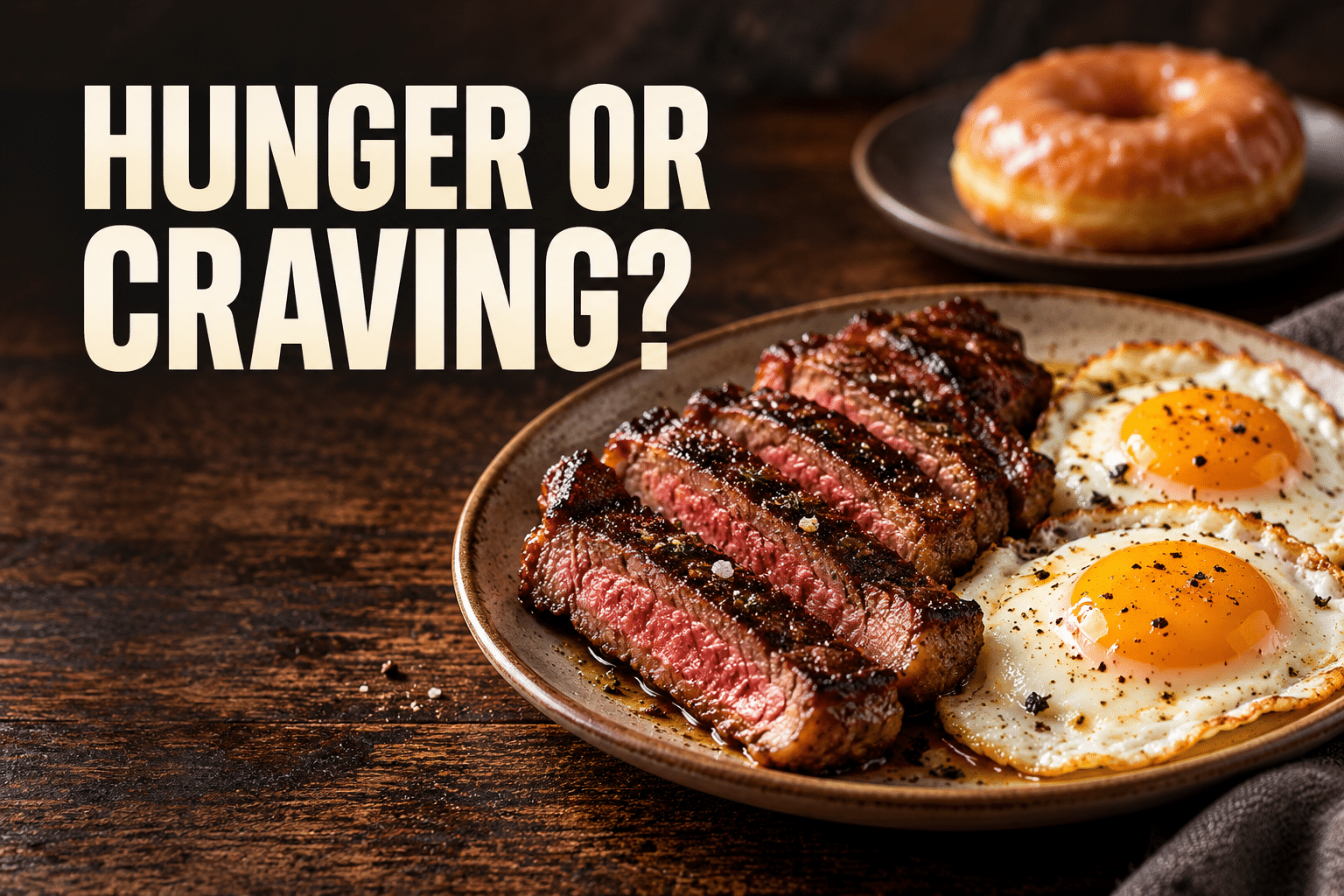
Yesterday, I answered the question, “How often should you eat on ketovore?” The answer depends largely on another question:
Am I actually hungry, or do I simply want something to eat?
Those two feelings can seem identical when I am standing in the kitchen staring into the refrigerator. Physical hunger needs nourishment. A craving may be caused by habit, stress, boredom, a tempting smell or the sudden appearance of donuts at church. Learning to recognize the difference has helped me reduce unnecessary snacking without turning every hungry moment into a test of willpower.
What Is Physical Hunger?
Physical hunger is the body’s request for food. It generally builds gradually. Isn’t limited to one particular food. Can be delayed briefly without creating panic. May include an empty feeling in the stomach. Makes a normal meal sound appealing. Improves after eating enough food. Ends when I become satisfied. If steak, eggs, hamburger patties or leftover chicken sound good, I may genuinely need a meal.
Physical hunger doesn’t usually issue a detailed order. It says, “Please feed me.”
What Is a Craving?
A craving is usually a strong desire for a particular food, flavor or eating experience. Specificity and urgency are two characteristics commonly used to distinguish a craving from ordinary food desire. A craving often:
-
Appears suddenly
-
Demands one particular food
-
Feels emotionally urgent
-
Is triggered by seeing or smelling food
-
Appears at a familiar time
-
Continues even when the stomach is physically full
-
May disappear when attention moves elsewhere
Hunger might say, “I could eat.” A craving says, “I need chips right now, and steak will not be accepted as a substitute.”
Cravings and hunger can overlap, so the distinction is not always perfect. Research suggests that cravings are temporary, changing states that can rise alongside hunger and influence eating.
My Steak-and-Eggs Test
When I am unsure, I ask myself:
Would I eat steak and eggs right now?
It doesn’t literally have to be steak and eggs. It could be hamburger patties, chicken thighs or another basic protein-centered meal. If the answer is yes, I may be hungry. If the answer is, “No, but I would eat a donut,” I am probably dealing with a craving.
The test works because it removes entertainment from the decision. I am not asking whether something delicious sounds good. Delicious food almost always sounds good. I am asking whether my body wants nourishment badly enough to accept an ordinary meal.
Why Do Cravings Happen?
Cravings don’t necessarily mean that I am weak or that ketovore has stopped working. They can be connected to: habit, stress, boredom, poor sleep, food smells and advertising, social situations, memories associated with food, seeing other people eat, restricting food too aggressively and not eating a satisfying meal. My brain remembers routines.
If I regularly ate snacks while watching football, turning on the game may create the desire to eat—even if I just finished dinner. If Sunday morning meant coffee and donuts, arriving at church may trigger that expectation before I see the first pink box. The location, activity and food have become connected.
Sleep Can Affect Hunger
A bad night of sleep can make food decisions harder. The National Institute of Diabetes and Digestive and Kidney Diseases notes that inadequate sleep may disrupt hormones involved in appetite. The CDC also reports that insufficient sleep can affect hunger regulation and contribute to less healthy food choices.
That doesn’t mean every craving is caused by one late night. It means sleep belongs in the conversation. If I am unusually hungry after sleeping poorly, I may need a solid meal and an earlier bedtime—not an argument with myself about discipline.
Stress Can Look Like Hunger
Food can provide a temporary distraction from stress. After a difficult meeting, busy workday or frustrating conversation, eating gives me something enjoyable and immediate to do. The problem is that food doesn’t solve the original source of the stress. Before eating, I can ask:
-
What happened just before this urge appeared?
-
Am I physically hungry?
-
Am I trying to change how I feel?
-
Would a real meal satisfy me?
-
Is there another action I can take first?
Sometimes the answer is still to eat. The value is in making that choice consciously instead of discovering afterward that stress ordered dinner.
My Five-Minute Hunger Check
When I cannot tell whether I am hungry or craving something, I use a brief check.
1. Pause
I don’t immediately tell myself yes or no. I wait five minutes. A craving may lose intensity when I interrupt the automatic response.
2. Consider My Last Meal
Did it contain enough protein? Was it a real meal, or did I attempt to survive on coffee and optimism? If the last meal was small or several hours ago, hunger may be reasonable.
3. Name the Food I Want
Would several foods satisfy me, or will only one specific food work? The more specific the demand, the more likely it is to be a craving.
4. Identify the Trigger
Did I see an advertisement, smell food, become stressed or walk into a familiar eating environment? Recognizing the trigger gives me information.
5. Make a Clear Decision
If I am hungry, I eat a proper meal. If it is a craving, I can wait, change activities or intentionally decide whether the food fits my plan. The purpose isn’t to create a courtroom trial every time I approach the refrigerator. It is simply to place a small gap between impulse and action.
What to Do When I Am Truly Hungry
If I am physically hungry, I don’t try to earn a medal by ignoring it. I eat. A useful ketovore meal might include: ground beef and eggs, steak, bunless hamburger patties, chicken thighs, pork chops, salmon, bacon and eggs, and leftover meat from the previous meal. I begin with protein and add enough fat to make the meal satisfying.
If I become hungry again shortly afterward, I examine whether the meal contained enough food—not whether I need stronger willpower.
What to Do With a Craving
If I identify a craving, I have several options. Wait ten minutes. Leave the kitchen. Drink water, black coffee or unsweetened tea. Take a short walk. Brush my teeth. Begin a task that requires my hands. Move the tempting food out of sight. Remind myself what I planned to eat next. Eat a protein-centered meal if the craving develops into genuine hunger. I am not trying to prove that I can suffer. I am allowing the craving time to pass before making a decision.
Fix the Environment, Not Just Your Willpower
It is easier to resist food that isn’t within arm’s reach. If a particular food repeatedly triggers unplanned eating, keeping it in the house may create a daily argument that doesn’t need to happen. I can also prepare for environments I cannot control.
Before a church event, football gathering or business lunch, I can eat a protein-centered meal beforehand. Decide what I will order in advance. Bring an appropriate option. Keep a drink in my hand. Move away from the snack table. Practice a simple “No, thank you.” A plan made before I see the food is usually stronger than one invented while smelling it.
Don’t Turn Hunger Into a Moral Failure
Ketovore should help me manage hunger. It should not make me ashamed of being hungry. Extreme restriction, frequently skipping needed meals or consistently eating too little may eventually make eating harder to control. NIDDK notes that unhealthy dieting practices—including skipping meals or not eating enough—may contribute to binge eating for some people.
That is why I don’t use fasting as punishment. If I overeat, my next step is a normal ketovore meal when I am hungry—not a forced fast designed to erase the previous day.
When to Ask for Help
Occasional cravings and overeating are common. However, regularly eating large amounts of food while feeling unable to control what or how much you eat can be a sign of binge-eating disorder. That isn’t a character flaw, and it isn’t something that must be solved alone.
A physician, registered dietitian or qualified mental-health professional can help when eating feels compulsive, secretive, distressing or out of control.
The Bottom Line
Physical hunger and cravings are not identical, but they can overlap. Hunger usually builds gradually and accepts a normal meal. A craving often appears suddenly and demands something specific. My simplest test is:
Would I eat a real protein-centered meal right now?
If yes, I eat. If no, I pause and look for the trigger. I won’t make the correct choice every time. That isn’t the standard. The goal is to become slightly more aware, slightly less automatic and better prepared to make the next choice intentionally. Sometimes my body needs steak. Sometimes my brain saw a donut. Learning which one is talking makes ketovore much easier.
Continue reading:
Disclaimer: I am sharing my personal ketovore experience, not providing medical or mental-health advice. If you regularly feel unable to control your eating or experience distress around food, speak with a qualified healthcare professional.

0 Comments