
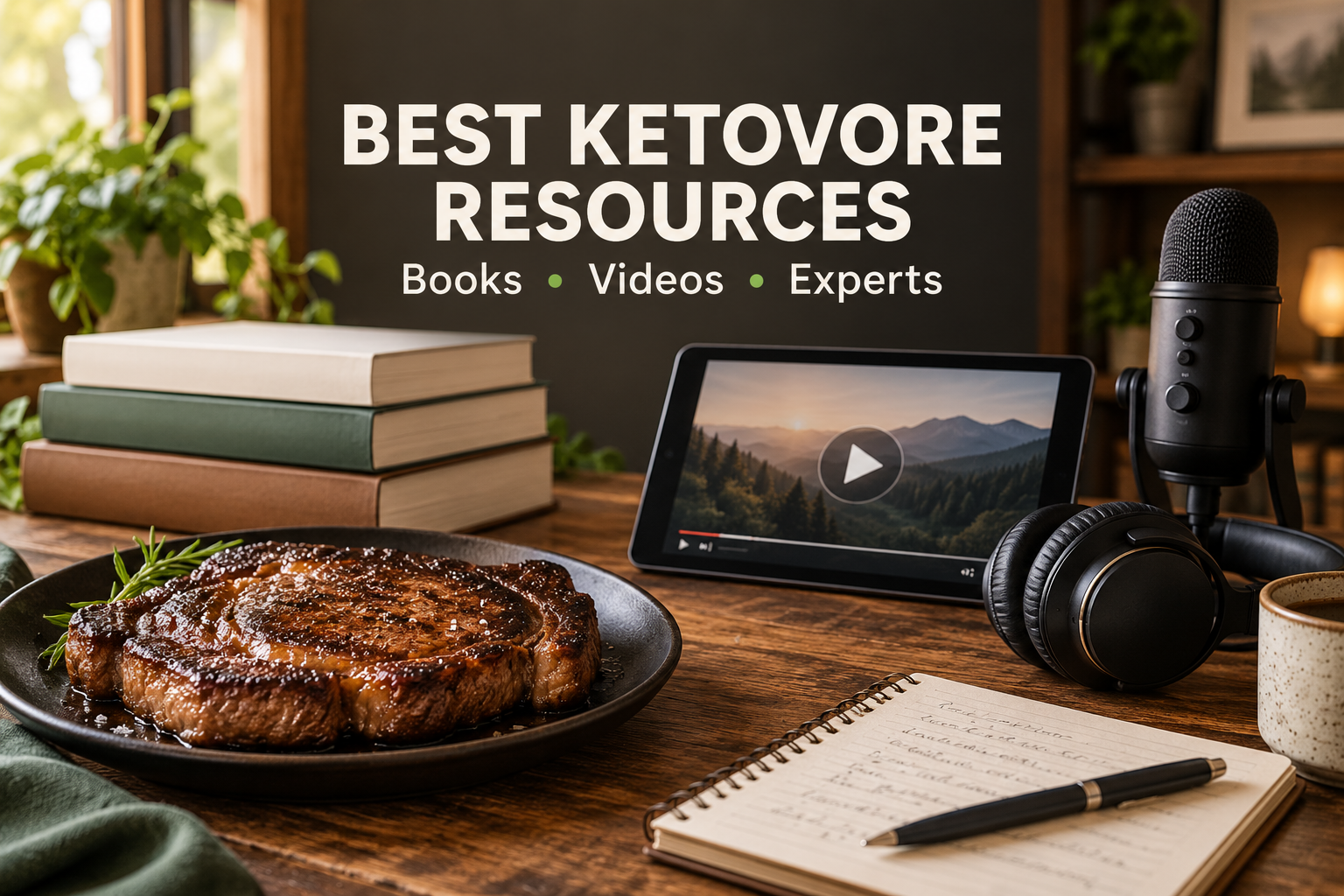
There is no shortage of information about keto, carnivore and low-carb eating. That is both good news and bad news. The good news is that you can learn almost anything without leaving your couch. The bad news is that anyone with a camera, a ribeye and a confident voice can present themselves as an expert.
I enjoy learning from books, websites, podcasts and YouTube channels, but I do not automatically accept every claim simply because someone owns a ring light and eats steak.
The resources below are the ones I would recommend as a starting point for someone interested in ketovore eating. Some are practical. Others dig more deeply into insulin, metabolism and nutrition science. A few come from the stricter carnivore side of the spectrum. I do not agree with every statement made by every person on this list (but Karen and I do agree with many of them). That is not the point. A useful resource should help us ask better questions, understand the reasoning behind a recommendation and make more informed decisions about our own health.
What I Look for in a Ketovore Resource
When I evaluate a book, video or website, I look for a few basic qualities:
- Does it explain why something may work?
- Does it offer advice that can be used in everyday life?
- Does it distinguish between research, clinical experience and personal opinion?
- Does it acknowledge that people may respond differently?
- Does it avoid promising a miracle cure?
- Does it encourage people taking medication to work with a qualified medical professional?
Personal experience still matters. My own ketovore journey is built around what I eat, how I feel, what I weigh and whether the approach is sustainable. But one person’s experience—even mine—is not proof that everyone will have the same result. With that in mind, here are some worthwhile places to begin.
Ketovore, Keto and Carnivore Books
1. End Your Carb Confusion by Dr. Eric Westman and Amy Berger
Best for: Beginners who want a straightforward low-carb plan.
If someone asked me for one practical book to help them begin reducing carbohydrates, this would be near the top of my list. Dr. Eric Westman has spent decades using low-carbohydrate nutrition in a clinical setting. The book focuses on choosing an appropriate carbohydrate level and keeping the eating plan simple enough to follow in real life. That practical approach fits the way I think about ketovore.
You do not necessarily need complicated recipes, expensive products or a spreadsheet tracking every molecule that enters your mouth. You need a dependable list of foods and a plan you can follow when you are hungry, busy or standing in a restaurant. This is a particularly helpful starting point for people who feel overwhelmed by conflicting keto rules.
2. Why We Get Sick by Benjamin Bikman, PhD
Best for: Understanding insulin resistance and metabolic health.
Love this book, big fan of Dr. Bikman. This is not specifically a ketovore instruction manual. It is a deeper look at insulin resistance and how it may relate to a wide range of metabolic conditions. Benjamin Bikman is a metabolic scientist, and the book helps explain why reducing carbohydrates may affect hunger, blood sugar, energy storage and other parts of metabolism.
I find this kind of information helpful because I do not want to know only what to eat. I also want to understand why a lower-carbohydrate diet might work. It is more scientific than a typical diet book, but it remains accessible to the average reader.
3. The Carnivore Diet by Dr. Shawn Baker
Best for: Understanding the strict carnivore end of the low-carb spectrum.
Ketovore and carnivore overlap, but they are not necessarily the same diet. Carnivore generally focuses on animal foods and may eliminate nearly all plant foods. Ketovore gives me more flexibility. Meat remains the foundation, but I can include selected low-carbohydrate foods when they work for me. Dr. Shawn Baker’s book provides a useful introduction to the arguments commonly made for carnivore eating.
You do not have to become a strict carnivore to learn something from the carnivore community. I use it as one end of the spectrum: a way to consider what happens when processed foods, sugar and most carbohydrates are removed.
4. Lies My Doctor Told Me by Dr. Ken Berry
Best for: Questioning familiar nutrition and health advice.
Love this one too. I liked it so much, I bought it for my Dad. The title is deliberately provocative, and Dr. Ken Berry is known for communicating in a very direct style. His work challenges several common assumptions about dietary fat, cholesterol, carbohydrates and conventional nutrition advice. He also produces a large amount of keto, carnivore and “Proper Human Diet” content through his website and YouTube channel.
I think books like this are most useful when they encourage us to investigate a subject further. They should not become an excuse to ignore medical care or assume every doctor is wrong. Ask questions. Request explanations. Review your results. But do not change medication based solely on something you read in a book or watched online.
5. The Art and Science of Low Carbohydrate Living by Jeff Volek, PhD, RD, and Stephen Phinney, MD, PhD
Best for: Readers who want more technical low-carb science.
This book digs more deeply into carbohydrate restriction, nutritional ketosis, adaptation and performance than most beginner keto books. It probably would not be my first recommendation for someone who simply wants to know what to eat tomorrow. However, it is a valuable resource for readers who want to move beyond social-media summaries and understand more of the scientific reasoning.
Think of it as a reference book rather than light bedtime reading—unless discussions of nutritional biochemistry are what help you fall asleep.
Ketovore and Low-Carb YouTube Channels
YouTube can be a wonderful educational tool. It can also turn one innocent search about breakfast into three hours of strangers arguing about blueberries. These are some channels and educational platforms I would use as starting points.
Dr. Ken Berry
Best for: Direct, practical keto and carnivore discussions.
Dr. Berry covers food choices, common keto mistakes, lab markers and frequently asked questions. His videos tend to be understandable and to the point. This is Karen’s FAVOR YouTube channel. His communication style is strong and his conclusions can be broader than those of more cautious educators. I treat his videos as a useful perspective, while still comparing important claims with other qualified sources.
Visit Dr. Ken Berry’s YouTube channel
Adapt Your Life with Dr. Eric Westman
Best for: Practical low-carb education with clinical experience behind it.
Dr. Westman’s approach is generally simple and structured. That makes his work especially helpful for someone who is new to keto and does not want to begin by calculating complicated ratios. His educational platform includes guidance based on his years of treating patients with low-carbohydrate nutrition.
Visit Adapt Your Life on YouTube
Diet Doctor
Best for: A broad collection of low-carb articles, interviews and videos.
Diet Doctor provides information on keto, low-carb eating, fasting, metabolic health and related topics. It features multiple physicians and researchers rather than depending on a single personality. That variety is useful because nutrition professionals do not always agree. Hearing more than one interpretation can help us separate well-supported principles from individual preferences.
Insulin IQ and The Metabolic Classroom
Best for: Deeper explanations of insulin and metabolism.
Insulin IQ is associated with Benjamin Bikman and focuses heavily on metabolic health. His podcast, The Metabolic Classroom, explores insulin resistance, energy metabolism and related subjects in greater depth. This is where I would go after learning the basic rules and deciding that I want to understand what may be happening inside the body.
Visit Benjamin Bikman’s website
Low Carb Down Under
Best for: Longer lectures from low-carb doctors and researchers.
Low Carb Down Under offers presentations and educational material from a variety of speakers. The content is more like attending a nutrition conference than watching a quick list of “five keto hacks.” That makes it useful when you want more context than a short social-media clip can provide.
Personal Stories Still Have Value
Not every useful ketovore resource needs to come from a doctor or scientist. Personal blogs, transformation stories and “what I eat in a day” videos can provide something research papers usually cannot: a view of what this way of eating looks like in ordinary life.
They can help with practical questions such as:
- What can I order at a fast-food restaurant?
- How do I handle donuts at church?
- What should I eat at a football watch party?
- How can I make ketovore more affordable?
- What happens if I make a bad choice?
- How do I get back on plan at the next meal?
The limitation is that a personal success story is still an anecdote. It can provide ideas and encouragement, but it cannot guarantee the same outcome for someone else. Use personal stories for inspiration. Use qualified medical care for diagnosis, medication decisions and individual treatment.
How I Use Ketovore Resources Without Becoming Confused
The more nutrition content you consume, the easier it is to become paralyzed by conflicting opinions. One person says to eat more fat. Another says to stop adding fat. One recommends fasting. Another insists that breakfast is essential. Someone else appears on your screen to warn that your favorite sweetener is personally plotting your downfall.
Here is a simpler approach:
Choose One Practical Starting Guide
Pick one straightforward plan and follow it consistently for a reasonable period. Constantly switching between five different systems makes it difficult to know what is working.
Learn the Basic Science Gradually
You do not need a degree in metabolism before eating your first bunless hamburger. Start with the practical food choices. Add the deeper science as your interest grows.
Change One Major Variable at a Time
If you change your diet, fasting schedule, exercise routine, supplements and sleep schedule on the same day, you will not know which change produced which result.
Track What Matters to You
Depending on your goals, this might include: Body weight, Waist measurement, Hunger, Energy, Sleep, Cravings, Exercise performance, Blood pressure & Laboratory results reviewed with your clinician.
Keep Advice in Context
A person treating severe diabetes may need a different plan from someone trying to lose ten pounds. An athlete may have different needs from someone who is largely sedentary. There is rarely one perfect protocol for every person in every situation.
My Suggested Ketovore Learning Path
If you are completely new to ketovore, here is a simple order I would follow:
- Read End Your Carb Confusion for a practical low-carb foundation.
- Watch several of Dr. Westman’s beginner videos.
- Use Dr. Ken Berry’s channel for practical keto and carnivore topics.
- Read Why We Get Sick to understand insulin resistance more deeply.
- Explore Insulin IQ and Low Carb Down Under when you want longer scientific discussions.
- Keep notes about your own meals, hunger, energy and results.
- Discuss medications, medical conditions and concerning symptoms with a qualified healthcare professional.
You do not have to consume everything at once. This is a lifestyle, not a final exam on Friday.
Ketovore Information I Would Treat Carefully
Be cautious when a person or website:
- Promises that one diet cures virtually every disease
- Tells everyone to stop taking prescribed medication
- Relies entirely on testimonials and transformation photographs
- Presents a personal opinion as settled science
- Claims one food is always perfect or always poisonous
- Insists that longer and more extreme fasting is automatically better
- Requires an expensive collection of supplements to make a basic diet work
- Never provides sources for major medical claims
- Suggests that you should avoid qualified medical care
Confidence is not the same thing as accuracy. A polished video and a large audience do not automatically make a claim true.
Build Your Own Ketovore Resource Shelf
This list is a starting point, not a declaration that these are the only people worth reading or watching.
My ideal resource shelf includes:
- A practical beginner book
- A deeper metabolic science book
- A few clinicians with low-carb experience
- Researchers who explain the underlying science
- Real people sharing honest daily experiences
- My own record of what is—and is not—working
I expect this resource list to grow as I discover new books, channels and experts worth sharing. The goal, however, is not to become a professional watcher of keto videos. The goal is to use good information to make a better decision at the next meal. That is where the real work happens.
Continue Exploring Ketovore
You may also enjoy:
- What Counts as a Fast?
- 24-Hour Fast vs. OMAD
- What I Eat in a Day on Ketovore
- My Simple Ketovore Grocery List
- How to Eat Ketovore at These 10 Fast-Food Restaurants
Disclaimer: This article is for general educational purposes and reflects personal opinions and experiences. It is not medical advice. Speak with a qualified healthcare professional before making major dietary changes, particularly if you have a medical condition, take prescription medication, are pregnant or have a history of disordered eating.

0 Comments