
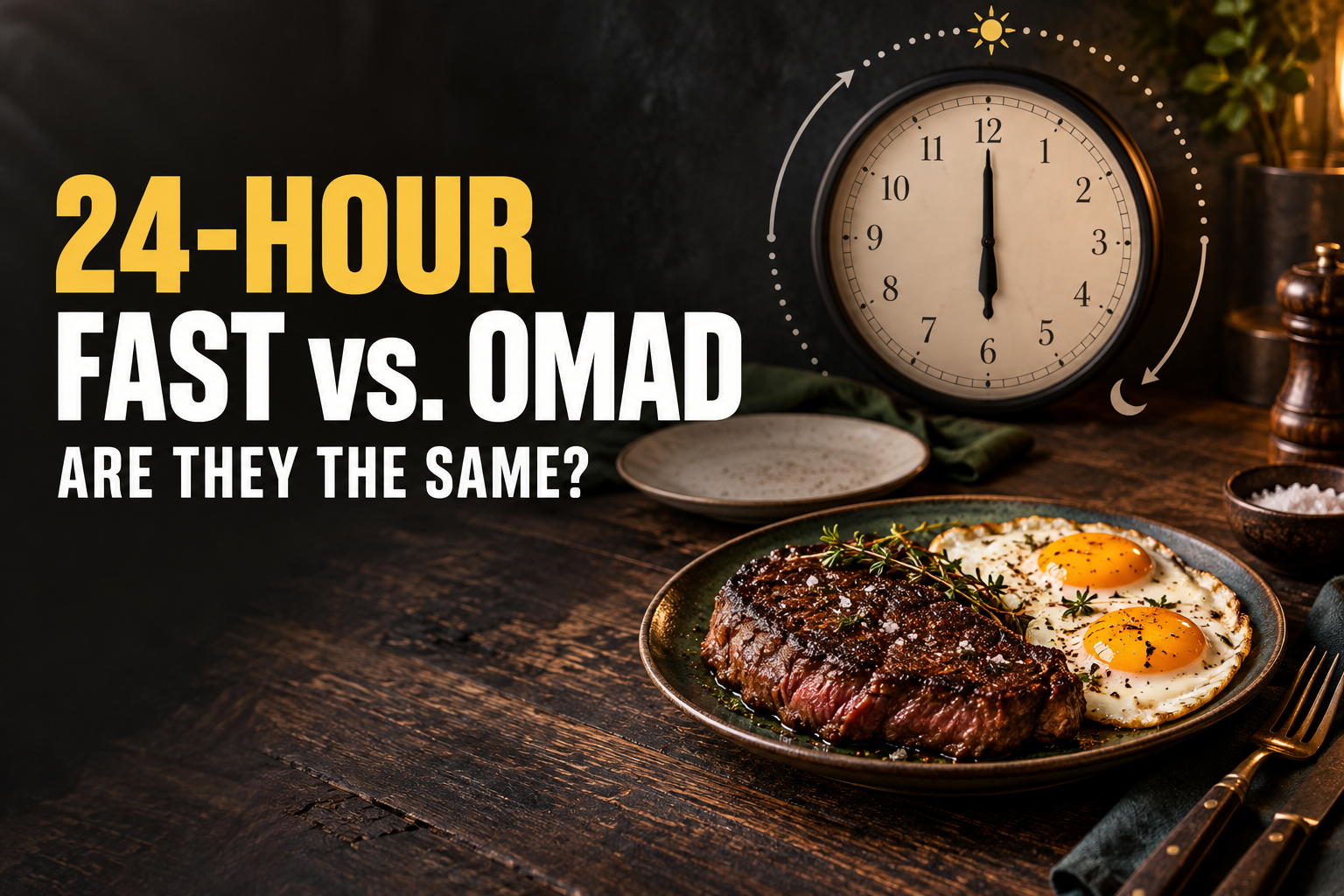
I have been experimenting with OMAD and 16:8 fasting as part of my ketovore journey. OMAD appeals to me because it is simple: I eat one satisfying meal, close the kitchen and stop making food decisions for the day. That sounds remarkably similar to a 24-hour fast. If I eat dinner tonight and do not eat again until dinner tomorrow, am I practicing OMAD, completing a 24-hour fast or somehow doing both? The answer is that OMAD and a 24-hour fast can look almost identical on the calendar, but they describe two slightly different things.
OMAD tells me how many times I eat. A 24-hour fast tells me exactly how much time passes between meals.
Let’s untangle the difference without requiring a calculator, a stopwatch or a fasting committee meeting.
What Is OMAD?
OMAD stands for one meal a day. The basic rule is straightforward: I eat once during the day, usually within a relatively short eating window. For example, I might begin dinner at 6:00 p.m., finish at 7:00 p.m. and wait until approximately 6:00 p.m. the following day to begin my next meal. In that example, I ate one meal on each calendar day. My eating window lasted about an hour, which means I fasted for approximately 23 hours. That is OMAD, but it is not technically a complete 24-hour fast.
OMAD describes meal frequency more than an exact fasting duration. Someone might eat lunch at noon on Monday and dinner at 6:00 p.m. on Tuesday. That person ate one meal each day, but the interval between those meals was 30 hours. Another person could eat at 7:00 p.m. Monday and 5:00 p.m. Tuesday. That is still one meal on each day, but only 22 hours passed between meals. OMAD is based on eating once per day. The clock can move around.
What Is a 24-Hour Fast?
A 24-hour fast means allowing a full 24 hours to pass between calorie-containing meals. The easiest example is dinner to dinner:
- Finish dinner at 6:00 p.m. Monday.
- Consume no calories afterward.
- Eat again at 6:00 p.m. Tuesday.
That is a complete 24-hour fast. It often sounds more intimidating when someone says, “I’m not eating for 24 hours.” Dinner-to-dinner feels more approachable because I still eat on both calendar days. I eat Monday evening, sleep through part of the fast, skip breakfast and lunch Tuesday and then eat dinner Tuesday evening. Sleeping through approximately one-third of a fast is an excellent strategy. It remains one of my strongest fasting skills.
Can OMAD Also Be a 24-Hour Fast?
Yes. If I begin each meal at approximately the same time every day, my OMAD schedule can create a 24-hour interval between the beginning of one meal and the beginning of the next. But if I measure from the end of one meal to the beginning of the next, a daily OMAD schedule often produces closer to 22 or 23 fasting hours. This does not mean OMAD is inferior or that those missing 60 minutes have destroyed the entire plan.
The difference matters primarily because fasting terms can become confusing. I want to understand what I am actually doing rather than choose the label that sounds most impressive. There is no fasting trophy engraved with “He Made It the Full 24.”
The Biggest Difference Is Frequency
A 24-hour fast can be something I do occasionally. For example, someone might complete a dinner-to-dinner fast once each week while following a more flexible 16:8 schedule on the other days. OMAD is often followed as a regular daily eating pattern. Someone may eat one meal nearly every day rather than schedule a specific weekly fast. That creates an important distinction:
- OMAD: one meal every day or on selected days.
- Twenty-four-hour fast: a measured 24-hour period without calories, performed occasionally or regularly.
I do not have to practice OMAD every day to complete a 24-hour fast. I also do not have to reach exactly 24 hours for a day to qualify as OMAD.
What Can I Have During a Strict 24-Hour Fast?
Under the simple definition I have been using, a strict fast means consuming no calories. During the fasting period, the usual choices are: Water, Black coffee, Plain unsweetened tea and Other genuinely calorie-free beverages. Johns Hopkins Medicine also lists water and zero-calorie beverages such as black coffee and tea as options during an intermittent fast. Anything containing calories ends a strict fast.
That includes my morning butter coffee. Butter coffee may still fit my low-carbohydrate eating plan, and it may help me delay a conventional meal, but it does not belong inside a clean 24-hour fast. Butter contains calories even when I give it a sophisticated name and blend it until it becomes foamy. If I want to complete a strict dinner-to-dinner fast, the butter has to wait until the fasting period ends.
Why Dinner-to-Dinner May Be Easier
A dinner-to-dinner schedule may feel easier than breakfast-to-breakfast or lunch-to-lunch for several reasons. First, it allows me to eat dinner with my family on both days. Second, much of the fast occurs overnight while I am sleeping. Third, the rules are clear. I finish dinner, stop consuming calories and eat again at dinner the following day.
The most challenging period would probably be my normal lunchtime. Hunger may appear because my body is accustomed to eating—or because the clock and refrigerator have been coordinating behind my back. Instead of assuming every hunger signal is an emergency, I can drink water, stay busy and see whether it passes. However, fasting is not supposed to become an exercise in ignoring serious symptoms. There is a difference between feeling hungry and feeling genuinely unwell.
Is 24 Hours Automatically Better Than 16:8 or OMAD?
No. A longer fast is not automatically a better fast. Johns Hopkins specifically cautions that fasting periods of 24, 36, 48 or 72 hours are not necessarily better and may be dangerous for some people. The institution recommends discussing intermittent fasting with a doctor before beginning, especially when medical conditions or medications are involved. For me, fasting is a tool for creating structure and reducing unnecessary eating. The objective is not to see how long I can endure hunger.
A consistent 16:8 schedule may work better than an occasional 24-hour fast followed by overeating. Likewise, a 23-hour OMAD schedule does not become useless simply because it stopped one hour short of 24. The best schedule is the one that helps me make better decisions without making the rest of my life unmanageable.
How I Would Prepare for a 24-Hour Fast
I would not prepare by eating an enormous “last supper.” The meal before the fast should be a normal, satisfying ketovore meal built around protein. That could include:
- Ground beef and eggs
- Steak
- Hamburger patties
- Chicken thighs
- Pork chops
- Bacon and eggs
- Meat with a modest amount of cheese or another low-carbohydrate addition
The goal is to finish satisfied, not painfully full. Eating twice as much because I plan to fast tomorrow defeats part of the purpose and may make me feel miserable before the fast even begins. I would also choose a relatively ordinary day. A day packed with intense exercise, business lunches and family celebrations may not be the ideal time to attempt a strict 24-hour fast. Planning matters.
How Should I Break a 24-Hour Fast?
The end of a fast is not permission to begin an eating competition. After 24 hours, it may be tempting to believe I have earned an enormous meal. That thinking can turn a structured fast into a cycle of restriction followed by overeating. I would break the fast with a normal ketovore meal:
- Start with meat or eggs.
- Eat slowly.
- Pay attention to fullness.
- Stop when comfortably satisfied.
- Avoid using the fast to justify dessert, excessive portions or continuous eating for the rest of the evening.
A 24-hour fast does not make calories disappear once the eating window opens. Fasting can reduce the number of opportunities I have to eat. It cannot make overeating invisible.
When Should I Stop a Fast?
I do not win anything by continuing when I feel genuinely unwell. Johns Hopkins advises speaking with a healthcare professional if intermittent fasting produces unusual anxiety, headaches, nausea or other concerning symptoms.
I should stop the fast and seek appropriate guidance if I experience significant weakness, confusion, fainting, persistent dizziness or another symptom that feels abnormal or unsafe. Fasting is supposed to support a healthier routine. It should not become a test of whether I can ignore my body longer than common sense recommends.
Who Should Get Medical Guidance First?
Intermittent fasting is not appropriate for everyone. According to Johns Hopkins, people who should avoid fasting or obtain professional direction include:
- Children and teenagers
- Pregnant or breastfeeding women
- People with type 1 diabetes who use insulin
- People with a history of eating disorders
Anyone with diabetes, another medical condition or medication affected by food timing should speak with a qualified healthcare professional before attempting a 24-hour fast. This blog describes what I am learning and experimenting with during my own ketovore journey. It is not individualized medical advice.
Would I Choose OMAD or a 24-Hour Fast?
For everyday life, OMAD is probably easier for me because it focuses on one simple rule: eat one meal. I do not necessarily need to watch the clock down to the minute. I plan one satisfying meal, eat it and close the kitchen. A strict 24-hour fast may be useful as an occasional, clearly defined challenge. Dinner-to-dinner provides a beginning and an end that are easy to understand. My practical approach would be:
- Use 16:8 when I need flexibility.
- Use OMAD when one meal fits naturally.
- Try an occasional 24-hour fast when the schedule makes sense.
- Do not treat changing the plan as a moral failure.
- Never assume longer automatically means better.
The fasting schedule needs to fit my real life, including client lunches, board meetings, family dinners, church events and football games. My life should not have to report to the fasting schedule for approval.
The Bottom Line
OMAD and a 24-hour fast are closely related, but they are not exactly the same. OMAD describes eating one meal during the day. Depending on the eating window, that may create approximately 22 or 23 hours without calories. A 24-hour fast measures a complete 24-hour period between calorie-containing meals. Dinner at 6:00 p.m. today followed by dinner at 6:00 p.m. tomorrow is the simplest example.
Sometimes an OMAD day will also be a 24-hour fast. Sometimes it will not. The distinction is useful, but I do not need to become obsessed with the label. For me, the real questions are simpler: Did the schedule reduce unnecessary eating? Did I remain hydrated and feel well? Did I break the fast with a reasonable meal? Can I follow the plan without making myself—or everyone around me—miserable?
If the answer is yes, the schedule probably did its job.

0 Comments
Trackbacks/Pingbacks