
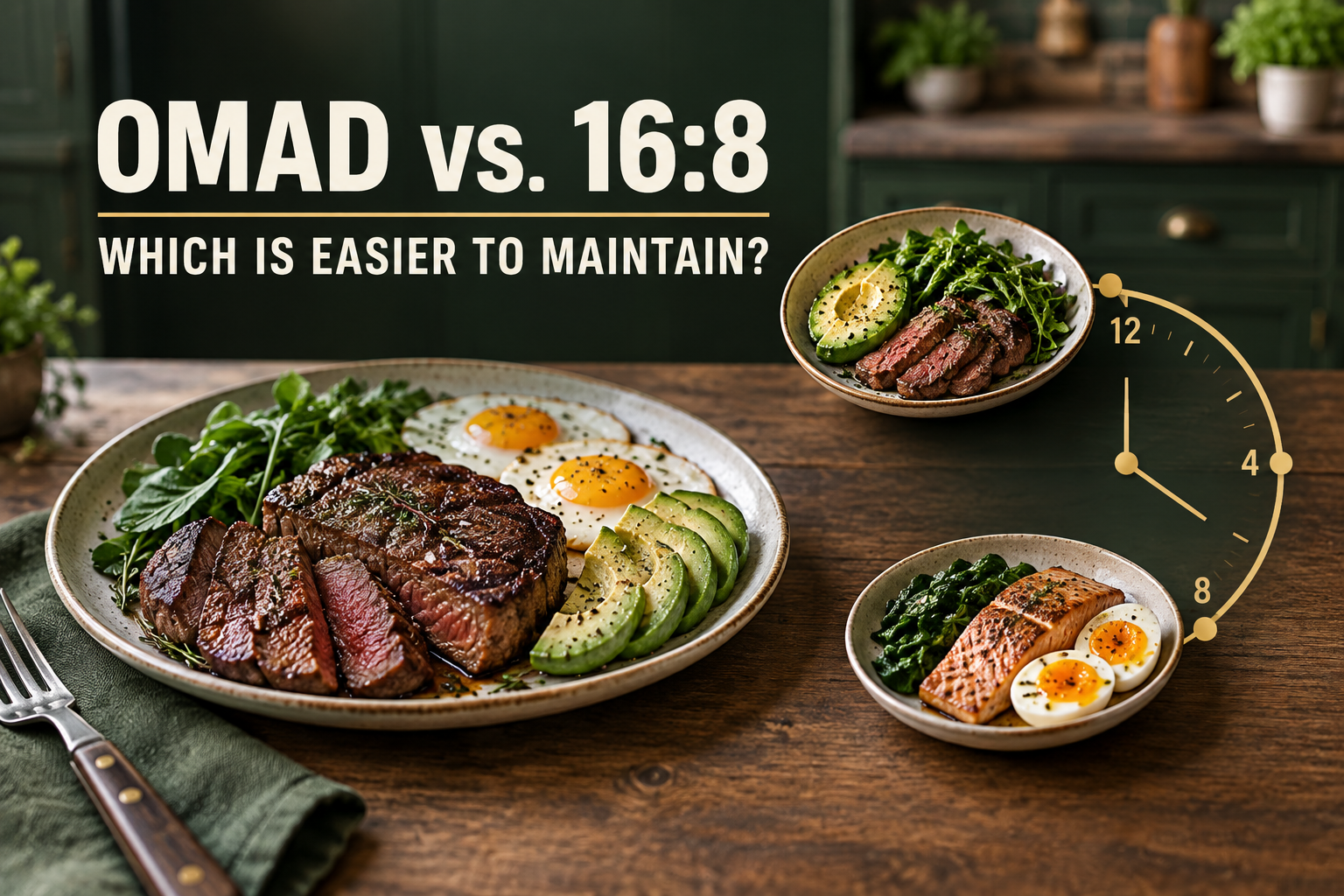
When people talk about intermittent fasting, two of the most common approaches are 16:8 fasting and OMAD—one meal a day. Both create a daily period without food. Both can reduce the number of times you eat. Both can be combined with keto or ketovore. However, living with them can feel completely different.
I have practiced both approaches during my ketovore journey. OMAD appeals to me because it eliminates decisions. I plan one satisfying meal, eat it, and close the kitchen. A 16:8 schedule gives me more flexibility, but it also creates more opportunities to eat. So which is easier to maintain? As usual, the answer depends on the person, the schedule, and whether someone leaves a tray of free cookies in the meeting room.
What Is 16:8 Fasting?
The 16:8 method divides the day into two parts:
- A 16-hour fasting window
- An eight-hour eating window
Someone might finish dinner at 7:00 p.m. and begin eating again at 11:00 a.m. the following day. Another person might eat between 9:00 a.m. and 5:00 p.m. The hours can be adjusted around work, family, and social commitments. During the fasting window, a clean fast generally allows water, black coffee, plain tea, and other genuinely calorie-free beverages. During the eight-hour eating window, meals and snacks are allowed.
Johns Hopkins Medicine identifies 16:8 as a common daily intermittent-fasting approach. It is popular because it isn’t dramatically different from skipping breakfast or ending food earlier in the evening.
What Is OMAD?
OMAD stands for “one meal a day.” Instead of eating during an eight-hour window, someone following OMAD consumes the day’s food during one meal or a relatively short eating period. Depending on the length of the meal, that may mean going approximately 22 or 23 hours without calories. OMAD is a more restrictive form of time-restricted eating.
I like it because the rules are simple. I don’t need to determine whether it is time for breakfast, lunch, a snack, or second lunch. I wait for my planned meal, eat, and I’m done. There is something freeing about removing food decisions from most of the day. Of course, simple does not always mean easy.
OMAD Wins on Simplicity
The greatest advantage of OMAD is that there is only one meal to plan. When I eat one meal, I have fewer opportunities to:
- Make an impulsive food choice.
- Turn a snack into an accidental meal.
- Eat because I am bored or stressed.
- Accept food simply because it is available.
- Spend the entire day negotiating with myself.
OMAD also works naturally with the way I prefer to eat ketovore. A substantial meal built around meat, eggs, and other satisfying low-carbohydrate foods can keep me full for a long time. Instead of preparing multiple smaller meals, I can concentrate on making one good decision. That simplicity is probably the biggest reason OMAD appeals to me.
16:8 Wins on Flexibility
Real life does not always cooperate with one meal a day. My schedule can include client lunches, board meetings, football games, family dinners, and other events built around food. With OMAD, an unexpected lunch can force me to choose between changing my planned meal or eating twice. A 16:8 window gives me room for both lunch and dinner.
For example, if a client wants to meet at noon, I can eat a ketovore lunch and still have dinner with my family before closing the eating window. I have not failed. I have simply used a more flexible schedule. That makes 16:8 easier to maintain socially. A fasting plan should help organize my life. My entire life should not have to reorganize itself around the fasting plan.
Which One Controls Hunger Better?
This depends heavily on the individual. For me, a satisfying OMAD meal can carry me through much of the following day. Ketovore foods tend to keep me fuller than the high-carbohydrate meals I used to eat. The challenging part is reaching the meal without turning hunger into an emergency.
A 16:8 schedule allows two meals and possibly a snack, which may prevent hunger from becoming overwhelming. It can also be a more comfortable transition for someone who is accustomed to eating throughout the day. OMAD may become easier after someone has adapted to a lower-carbohydrate diet and a shorter eating window. Jumping directly from three meals plus snacks to one meal could feel less like a lifestyle adjustment and more like a hostage situation. There is no prize for choosing the most uncomfortable schedule.
Can You Eat Enough Protein on OMAD?
This is one of OMAD’s practical challenges. When I only eat once, that meal has to do more nutritional work. I need adequate protein, enough total food, and some variety. That can be difficult to fit into one sitting without either undereating or becoming painfully full. A 16:8 schedule allows protein to be divided between two meals. Someone could eat eggs and meat at lunch and then have steak, chicken, pork, or fish at dinner.
Spreading protein across more than one meal may also be easier for people who exercise, want to preserve muscle, or simply cannot comfortably eat a large amount at once. OMAD should not mean surviving all day and then eating whatever fits on one plate. The quality and quantity of that meal still matter.
Which One Is Better for Weight Loss?
Neither schedule automatically guarantees weight loss. Fasting can reduce the number of opportunities to eat, but it does not repeal the laws of energy balance. It is possible to consume too many calories during an eight-hour window, and it is possible to consume a surprising amount during one enormous meal. Research comparing different meal frequencies remains limited and mixed. A systematic review of controlled trials found very low-certainty evidence and no clear weight advantage for higher- or lower-frequency eating patterns.
Research specifically on OMAD is especially limited. One small randomized crossover study involved only 11 healthy participants, so it cannot tell us how OMAD will affect everyone over the long term. That is why I look at fasting primarily as a tool for controlling my behavior. If OMAD helps me eliminate snacks and eat less overall, it may help me lose weight. If it causes me to become so hungry that I overeat during my meal, it may work against me. The same principle applies to 16:8.
The Overeating Problem
I have already learned that eating the correct foods does not make quantity irrelevant. I can eat meat, eggs, cheese, and other ketovore foods and still eat more than I need. That becomes especially tempting after a long fast. There is a dangerous little voice that says, “You fasted all day. You earned this.” That voice rarely recommends a reasonable portion.
OMAD can create an all-or-nothing mentality in which the single meal becomes an event. A 16:8 schedule may reduce that pressure because another meal is allowed within the window. On the other hand, an eight-hour window can become eight hours of grazing if I do not set boundaries. For me, either approach needs a plan:
- Decide what I will eat.
- Build meals around protein.
- Eat until comfortably satisfied.
- Avoid using the eating window as a countdown to unlimited food.
- Stop when the planned meal is finished.
Which Is Better for Business Lunches?
For my schedule, 16:8 is usually easier on days with business lunches. I can steer the client toward a place where I can make a ketovore choice—like I recently did with Wingstop—and still have room for a family meal later. OMAD can also work if I make the business lunch my one meal. The problem is that restaurant meals do not always provide enough appropriate food to carry me comfortably until the following day.
There is also the social reality that my family may expect me at dinner. Telling everyone I already completed my daily food allotment with a client at noon is not always the most enjoyable solution. Flexibility can prevent one unusual meal from turning into an excuse to abandon the entire day.
What About Football Games and Social Events?
These are the situations that test any fasting schedule. If I know food will be served at a football game, I can make that my OMAD meal. However, I also need to decide in advance what and how much I will eat. “Only meat” can still become too much meat when I return for seconds and thirds. With 16:8, I could have a smaller meal earlier and then eat appropriately at the game. That may reduce the feeling that I need to consume an entire day’s worth of food from one buffet tray.
The important decision happens before I arrive. A fasting window does not protect me from poor choices once it opens.
My Practical Approach: Use Both
I don’t believe I need to choose one schedule forever. OMAD works well on simple days when I control the timing and content of my meal. It reduces decisions and gives me clear boundaries. A 16:8 window works better when I have a client lunch, family dinner, evening event, or demanding workout. It gives me flexibility without turning the day into unrestricted eating.
My approach is to use OMAD selectively rather than force it every day. That means:
- OMAD on days when one meal fits naturally.
- 16:8 on days that realistically require two meals.
- Ketovore food choices during either schedule.
- No treating a schedule change as a failure.
Changing from OMAD to 16:8 is not cheating. It is still a structured fasting day. The danger is not moving from one reasonable plan to another. The danger is declaring the plan ruined and using that as permission to eat anything for the rest of the day.
Which Is Easier for Beginners?
For most beginners, 16:8 is probably the more approachable starting point. It can be created by eliminating late-night eating, delaying breakfast, or doing both. Once 16:8 feels normal, someone can experiment with a shorter window or an occasional OMAD day. OMAD requires more planning and makes it harder to distribute protein and nutrients across the day. It may also produce stronger hunger, fatigue, headaches, or irritability in some people.
Intermittent fasting is not appropriate for everyone. Children, pregnant or breastfeeding women, people with a history of eating disorders, and people managing diabetes or medications affected by meal timing should seek professional medical guidance before fasting. Mayo Clinic also notes that the long-term health effects of intermittent fasting are not yet clear.
The Winner Is the Schedule You Can Maintain
OMAD wins on simplicity. 16:8 wins on flexibility. Neither one wins if it repeatedly causes me to overeat, abandon my plan, or feel miserable. The best fasting schedule is not necessarily the longest, strictest, or most impressive one. It is the schedule that helps me control unnecessary eating while still fitting into my actual life. For me, that may mean OMAD today and 16:8 tomorrow.
The goal is not to achieve perfect fasting attendance. The goal is to make steady progress, eat appropriate foods, and build habits I can continue after the excitement of starting has worn off. Consistency beats extremity. And if a fasting plan cannot survive a business lunch, a football game, and dinner with my wife, it probably needs a little more flexibility.

0 Comments