
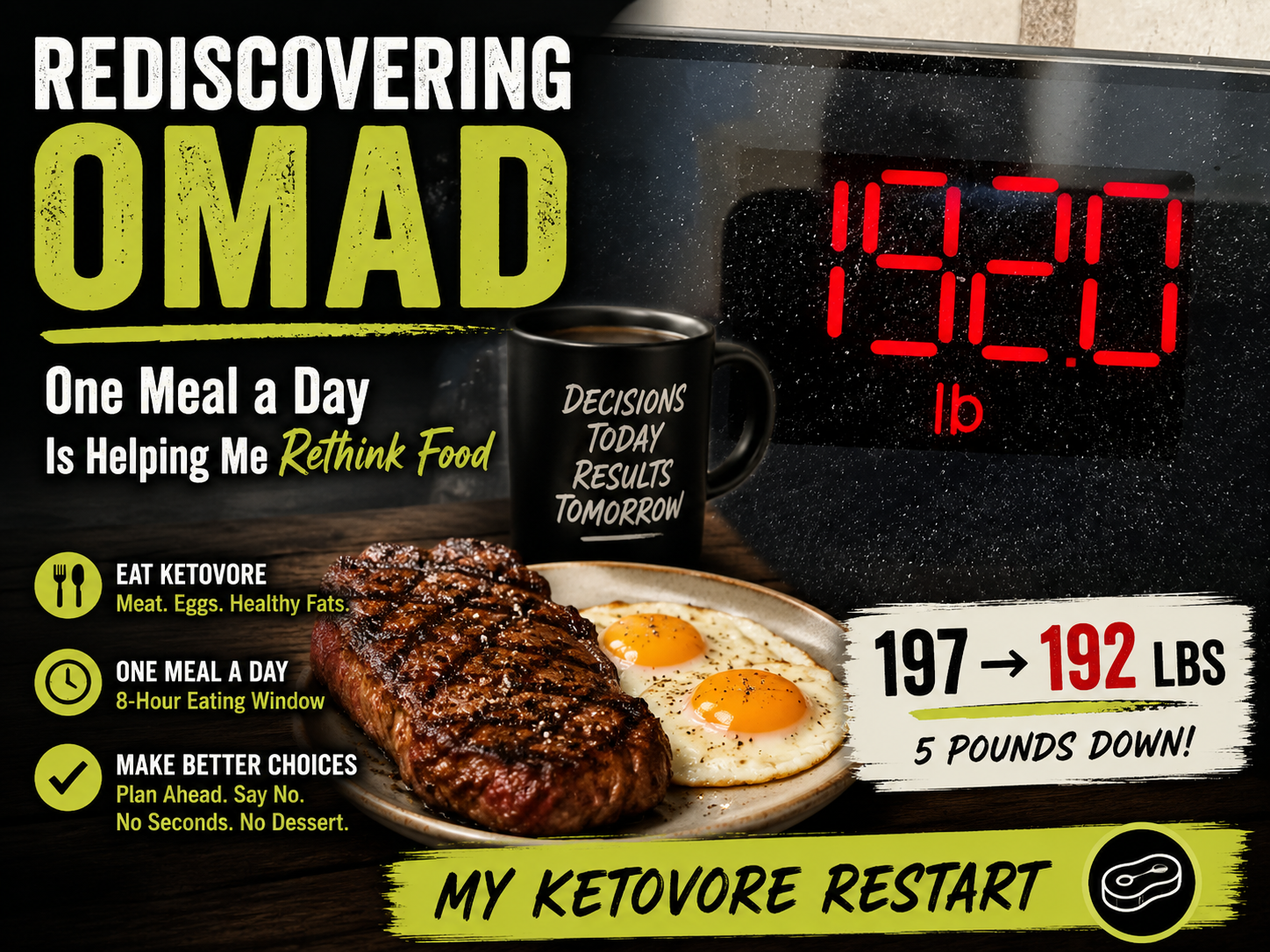
192.0 pounds. That’s what the scale said this morning. I started this restart at 197 pounds, so seeing 192 obviously feels good. But I’m trying not to get overly excited about five pounds on the scale. Weight can move around quite a bit, especially when you change how you’re eating. What’s more interesting to me is what’s happening in my head.
I’m starting to think about food again. More specifically, I’m starting to think before I eat. And yesterday, that meant going back to something I’ve done before: OMAD — One Meal a Day.
What Is OMAD?
OMAD is pretty much exactly what it sounds like. Instead of eating breakfast, lunch, dinner and snacks throughout the day, you eat one primary meal. It’s a form of intermittent fasting where most of the day is spent fasting and your food is consumed during a relatively short eating window. I’ve done intermittent fasting for years to varying degrees. Even when I wasn’t particularly disciplined with my ketovore diet, I generally ate only one or two meals per day. So OMAD isn’t some revolutionary new discovery for me.
It’s actually more of a reset. Yesterday I ate one meal. And I was fine. That’s worth remembering.
One of My Problems Is Simply Eating Too Much
When I wrote about my 30-day restart, I identified two major problems with how I’ve been eating. The first is what I eat when I’m away from home. The second is how much I eat. OMAD potentially helps me with both. If I’m only eating one substantial meal, I’ve eliminated a bunch of opportunities to make bad decisions.
No breakfast decision. Maybe no lunch decision. No grazing throughout the afternoon. No random snack because I’m walking through the kitchen. It simplifies things. And I’m beginning to realize that simplification may be exactly what I need.
Eating Ketovore Doesn’t Give Me Permission to Overeat
Thursday night gave me a perfect example. I was at a football game. Eating at events is one of the situations I’ve identified as difficult for me, so I tried to be conscious of my choices. And I did something right. I ate meat. I stayed away from the junk. That’s a win.
But I also went back for seconds. That’s the part I’m trying to notice now. A few weeks ago, I might have simply congratulated myself for eating low-carb food. “Hey, I ate meat. I’m doing great!” Except my goal isn’t merely to eat the correct category of food. I’m trying to get healthier and lose weight. If I’m already satisfied, going back for another plate simply because the food is available isn’t helping me accomplish that. That’s the behavior I’m trying to change.
The Starbucks Test
Then today I met my Saturday morning Starbucks group. This is exactly the kind of situation I’ve been talking about. My job puts me around food. Client meetings. Coffee shops. Lunch meetings. School board events. Football games. Restaurants. Catered meals. I’m simply not going to eat every meal at home.
So my solution can’t be: Avoid the world until I lose weight. I have to learn how to make better choices while living my normal life. Today I walked into Starbucks and actually thought about what I was going to order. I ended up with an Americano with heavy cream. No pastry. No sugary coffee drink. No “I’ve been good all week, so this doesn’t count.” Just coffee. That sounds like an incredibly small victory. I think it’s actually a pretty important one.
I’m Learning to Put a Pause Between Opportunity and Eating
That’s what I’m noticing during this restart. Food appears. And instead of automatically eating it, I’m beginning to ask: Do I actually need this? That’s new—or at least renewed. At the football game: Meat? Yes. Seconds? Probably didn’t need them. Yesterday: Do I really need multiple meals today? No. Today at Starbucks: Do I need something to eat just because I’m meeting a client at a place that sells food? No.
That’s what I mean when I say I’m starting to rethink food. I’m putting a little space between “food is available” and “Fred eats it.” Apparently those two events don’t actually have to occur together. Who knew?
Is OMAD Going to Be My Everyday Plan?
I don’t know yet. And that’s part of what I’m going to figure out. I’m not declaring that I’m going to eat exactly one meal every day for the rest of my life. Some days OMAD may work beautifully. Other days two meals within an eight-hour window may make more sense. I’m also exercising, walking about 8,000 steps per day, going to the gym and trying to become more consistent with spin class. I need to pay attention to how I feel and whether I’m adequately fueling myself rather than turning this into a contest to see how little I can eat.
This isn’t medical advice, either. I’m simply documenting what I’m trying and how my body responds. For now, OMAD is another tool. And I like what it does psychologically. It gives me a very simple answer: I’m not eating right now. There’s surprisingly little negotiation involved.
197 to 192
So that’s where I am today. Starting weight: 197.0 pounds Today’s weight: 192.0 pounds I’m five pounds lighter on the scale. Again, I’m not pretending that’s five pounds of body fat. Bodies don’t work that neatly. What I’m more encouraged about is that I’m starting to make deliberate decisions again. I ate meat at the football game. Next time, I’ll work on skipping the seconds. I successfully did OMAD yesterday. I walked into Starbucks today and walked back out with an Americano and heavy cream.
Small decisions. Nothing dramatic. But I’m beginning to think that’s what this entire journey is going to be about. Not one giant decision to “get healthy.” Hundreds of little decisions that eventually add up to getting healthy. Today, I’m 192. And I’m still going.

0 Comments