
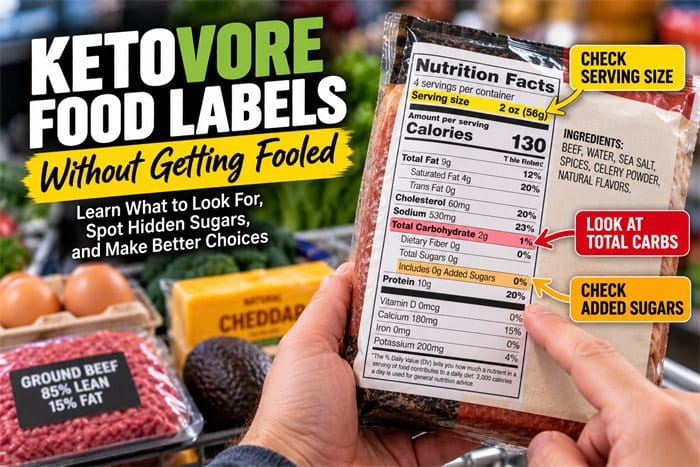
I’ve decided there should be a college course on reading food labels. Seriously. You walk into the grocery store looking for something simple to eat. You pick up a package that proudly announces “KETO FRIENDLY” in giant letters. Wonderful!
Then you turn the package around and discover an ingredient list that looks like somebody spilled a chemistry textbook into the food. And suddenly, you’re standing in aisle seven trying to figure out what sugar alcohols are and whether twelve grams of carbohydrates are really only two. Welcome to modern grocery shopping. The good news is that you don’t need a nutrition degree to make better decisions. You just need to understand a few important things about food labels.
Let’s break it down.
1. Ignore the Front of the Package First
This might be the most important advice in this entire article. The front of a food package is advertising. Its job is to get your attention and convince you to buy the product.
That’s why you’ll see phrases like: Keto friendly, Low carb, No added sugar, Sugar free, High protein & Zero net carbs. Some of these claims have specific regulatory definitions. Others, including many uses of “keto friendly,” do not establish that a product meets your personal carbohydrate goals.
And a food can be low in sugar while still containing significant carbohydrates. Instead of making your decision based on the front of the package, flip it over. The Nutrition Facts panel and ingredient list will tell you much more.
2. Start With the Serving Size
Here’s a sneaky little detail that can change everything. Serving size. Imagine picking up a package of low-carb cookies. The front says two grams of net carbs. Sounds pretty good. But then you discover that the serving size is one cookie. And there are twelve cookies in the package. Suddenly, eating the entire package is a very different nutritional decision.
Always check:
- The serving size.
- The number of servings per container.
- How much you’re actually planning to eat.
If a food contains five grams of total carbohydrates per serving and you eat three servings, you’ve consumed fifteen grams of total carbohydrates. That’s not complicated math. But it’s easy to overlook when the package is doing everything possible to make the number look small.
3. Understand Total Carbs Versus Net Carbs
This is where things get interesting. Total carbohydrates include several different components, including sugars, starches, and dietary fiber. People following ketogenic diets often calculate something called net carbs.
A common calculation is: Net carbs = Total carbohydrates − Dietary fiber Some manufacturers also subtract certain sugar alcohols. However, there’s an important catch. Not all sugar alcohols behave the same way in the body, and their effects on blood glucose and digestion can vary. Net carbs are also not a standardized nutrient listed on the FDA Nutrition Facts panel.
For example, consider a product with:
- Total carbohydrates: 15 grams
- Dietary fiber: 8 grams
- Total sugars: 2 grams
Subtracting the fiber gives seven grams under the basic net-carb calculation. But that doesn’t automatically tell you everything about how the product will affect you. If you’re managing diabetes, carbohydrate counting and medication decisions should follow your healthcare team’s guidance rather than relying on marketing claims about net carbs.
4. Look for Hidden Sources of Sugar
Sugar has a remarkable ability to appear in places you wouldn’t expect. Salad dressing. Barbecue sauce. Beef jerky. Marinades. Bacon. Even some products marketed toward people avoiding carbohydrates.
When reading ingredient lists, watch for terms such as: Sugar, Corn syrup, Honey, Molasses, Dextrose, Maltose, Rice syrup & Agave syrup. These are all forms of added sugar or sweetening ingredients. The Nutrition Facts panel also includes an Added Sugars line, which can help you compare products. Keep in mind that ingredient lists are ordered by weight, with the largest ingredient amounts listed first.
If sugar appears near the beginning, that may be a reason to look more closely at the product. You don’t have to become the carbohydrate police. Just understand what you’re buying.
5. Don’t Assume Sugar-Free Means Carb-Free
This is another common mistake. A product can contain zero grams of sugar and still contain carbohydrates. Why? Because sugar is only one type of carbohydrate. Other ingredients, including starches, may contribute carbohydrates even when a product has little or no sugar. Sugar-free candy is a good example. Some products contain sugar alcohols, which can still contribute calories and may cause digestive discomfort when consumed in larger amounts.
So when you see “sugar free,” don’t stop reading. Check the total carbohydrate line. Then look at the ingredients. Your digestive system may appreciate the extra research.
6. Check the Protein, Too
Since we’re talking about ketovore, let’s not forget the protein. For many people, protein is one of the foundations of this eating approach. When comparing foods, look at the protein content alongside the serving size, calories, fat, and carbohydrates.
For example, a product advertised as a high-protein snack might contain: 8 grams of protein, 20 grams of fat & 250 calories. That doesn’t automatically make it a bad food. But it does mean you should understand what you’re getting.
A simple serving of meat, eggs, fish, or another protein-rich food may be a more straightforward option. Protein is important for maintaining muscle and supporting normal body functions, especially during weight loss. However, your individual protein needs depend on factors such as body size, activity, age, and health.
7. Don’t Forget About Calories and Portions
Here’s something that sometimes gets lost in conversations about ketogenic diets. Calories still matter. A food can be very low in carbohydrates and still contain a substantial amount of energy. Cheese. Nuts. Butter. Heavy cream. These foods can fit into some low-carb eating patterns, but portion sizes can make a difference when weight management is the goal.
This connects with an earlier lesson I shared in The Ketovore Mistake I Keep Making: Eating Too Much of the Right Foods. Choosing foods that fit your plan is useful. Paying attention to how much you’re eating is useful, too. You don’t necessarily need to count every calorie. But assuming that low-carb means unlimited can create problems.
8. Compare Foods Instead of Looking for Perfect Foods
One of the best uses of nutrition labels is comparison. Suppose you’re choosing between two packages of beef jerky. One has six grams of added sugar per serving. The other has zero grams of added sugar. If both provide similar amounts of protein and otherwise fit your needs, the second may be the more practical choice for reducing added sugar.
Or perhaps you’re comparing two salad dressings. One contains twelve grams of carbohydrates per serving. The other contains two. The labels make it easier to choose. You don’t need every food to be perfect. You just need enough information to make a reasonable decision.
9. Sometimes the Best Foods Don’t Need a Nutrition Label
Here’s my favorite part. Some of the most straightforward foods for a ketovore approach are ordinary, minimally processed ingredients. Fresh beef. Chicken. Eggs. Fish. Pork. Certain vegetables. These foods generally don’t need flashy “keto approved” labels to explain what they are.
Of course, it’s still important to consider overall nutritional balance, food preparation, and individual health needs. But there is something refreshing about buying food without needing to decode seventeen marketing claims. Sometimes a steak is just a steak. And that’s a beautiful thing.
10. My Simple Food Label Checklist
The next time you’re shopping, try this quick checklist.
First: Check the serving size.
Second: Look at total carbohydrates.
Third: Review dietary fiber and added sugars.
Fourth: Read the ingredient list.
Fifth: Check protein and calories.
Sixth: Compare similar products before deciding.
You don’t need to spend ten minutes analyzing every item in your cart. But taking an extra thirty seconds on unfamiliar packaged foods can help you avoid surprises.
Final Thoughts: Become an Informed Shopper
One of the things I appreciate about learning to eat differently is that it forces you to pay attention. You begin noticing how much sugar appears in everyday foods. You recognize that serving sizes aren’t always what you expected. And you discover that a product labeled “keto friendly” isn’t necessarily the best choice for your particular goals. That’s valuable knowledge.
Not because every carbohydrate is bad. Not because packaged foods should always be avoided. And certainly not because everyone needs to follow the same diet. But because understanding food labels gives you more control over your decisions. So the next time you’re in the grocery store and see a product promising zero net carbs, turn it around. Read the label. Check the serving size.
And remember that the biggest letters on the front of the package aren’t always the most important information. Sometimes the truth is hiding in eight-point type on the back.
Disclaimer: This article is for general educational purposes and is not medical or individualized nutrition advice. People managing diabetes or other medical conditions should consult their healthcare team about carbohydrate intake and dietary changes.

0 Comments